
Hidden Histories of Lake County
As America marks 250 years, discover the people, places and stories that shaped our county and the nation.
Written by: Dan Maxson
America 250 is a nationwide initiative that began many years back and continues through 2033. While the main focus is celebrating America’s 250th birthday this year and sharing the rich American Revolutionary War events leading up to our nation’s birth, it is also meant to be a time to celebrate the unique fabric of America – the histories of our own local counties and communities.
While it is a fact that Ohio was granted statehood in 1803, and 1840 marked the addition of Lake County to the state roles, it was the 88 American Revolutionary War Patriots who settled in our county that bear retelling . These stories became the foundation of our early American history, and their contributions transformed an emerging nation agriculturally, academically, industrially and culturally. What follows are some of our county’s hidden gems and historical roads less traveled.
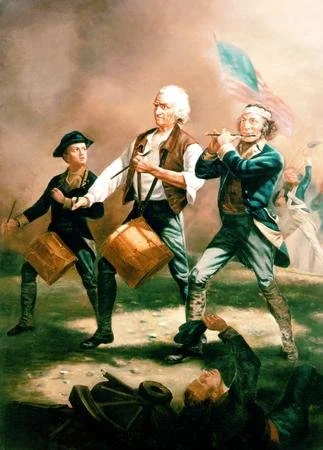
Lake County is Ohio’s smallest county with the most state history. With 27 historical markers countywide, one can visit each location in 2026. Not to be missed are markers 7-43 Hugh Mosher and 16-43, Henry Kelsey Deverieux. They were the young boys chosen to portray the Fifer and Drummer in Archibald Willard’s famous painting Spirit of ’76. A second copy of that painting is on display at Wickliffe City Hall. Marker 27-43 shares the story of Indian Point and the Native Americans who lived on the Grand River. Marker 24-43 tells the history of opulence and Cleveland’s Gilded Age with the Coulby Mansion while marker 11-43 relates the history of noted Ohio educator Thomas A. Harvey.
Lake County by the Numbers
227 square miles of land, making it Ohio’s smallest county by land area
77% of the county extends into Lake Erie, shaping early settlement and trade routes
88 revoluntionary War patriots helped shape the county
27 historical markers tell Lake County’s story
39+ historical sites perserved within Lake Metroparks
2 Frank Lloyd Wright homes reflect mid-century design
The City of Painesville, our county seat, has a walkable history for everyone. Whether you follow the ‘hitching post’ map, visit the former Federal Reserve Bank with its treasury vault and National Bank site at 105 Main Street, or view the historic homes along Mentor Avenue, Wood or Bank Streets there is much to learn. Historical marker 12-43 is the Casement House where the history of Francis Jennings and her husband Jack Casement encompass the American History chapters of the Civil War, transcontinental railroad and earliest suffrage movement. Additionally, the county suffragette movement is clearly examined on the Lake Erie College campus with a dedicated walkway in front of College Hall. One can examine the stories and contributions that Jennings, Elizabeth Cody Stanton and Susan B. Anthony made to our county. Madison Township is the site of the Abraham Tappan home. Tappan was a surveyor, Western Reserve land agent, educator and judge. Also located nearby are the Connecticut Land Company Office and the well-known Unionville Tavern.
Events
Liberty Tree Planting
May 21 | Veterans Park Painesville
America 250 Picnic
June 14 | Lake County History Center
Lake County America 250 Celebration
July 4 | Classic Auto Group Park
Lake County Fair America 250 Bobble Head Giveaway
August 1 | Lake County Fairgrounds
With more than 39 properties, Lake Metroparks offers many opportunities to binge walk county footprints in time. Beaty Landing and Big Creek at Liberty Hollow are pivotal stories in county Underground Railroad history. The Lake Erie Bluffs and the former Parmly House located in Perry was home to perhaps the greatest family of early dentists. Gildersleeve Mountain and the quarries of Chapin Forest in Kirtland echo the pioneer settler histories and stories of the Mormon migration of 1831-1836.
Three old schoolhouses, the 1840 Old Stone School in Concord Township, the 1894 Schoolhouse in Kirtland and the 1901 Red Schoolhouse in Willoughby provide a glimpse into public education in its infancy. Transportation history can be experienced at the Painesville Railroad Depot, through the Vulcan Car Company exhibit at the Lake County History Center or the important county aviatrix stories of Margaret Hurlburt, Patricia J. Hange, Gretchen Reed and Connie Luhta. Two Frank Lloyd Wright homes are located in Lake County. They are the 1950 Karl Staley home located in North Madison and the 1952 Louis Penfield House in Willoughby Hills that includes the recently completed River Rock site. Elsewhere, 54 buildings comprise the Mentor Avenue Historic District and depict every important architectural style of the day.
As America celebrates its semi quincentennial year, it is fair to say the events leading up to and including the Revolutionary War Era spanned north to Quebec City, south to Spanish-held territories on our southern coast, west into French held lands and into the Ohio territory. The patriots who moved to our future state contributed to the “heart of it all” then and to this day. Your challenge for 2026 is to tour Lake County, its many backroads, contributions to Ohio’s history and America’s past and all the hidden gems and stories along the way…and it is always a one tank trip!
What is America 250?
America 250 is a nationwide commemoration marking the 250th anniversary of the United States. The initiative encourages communities across the country to reflect on the people., places, and events that shaped the nation leading up to its founding and beyond.
While the semi quincentennial celebrates America’s 250th birthday, the observance spans several years, giving states and local communities time to share their own stories. These local histories help illustrate how the ideals of the Revoluntionary era reached for beyond the origional colonies.
America 250 invites visitors and residents alike toe explore Lake County’s historical markers, preserved sites, and hidden stories that connect local history to the nation’s past.